The UK built environment has an urgent requirement for new homes and swathes of redundant office and commercial space. Martin Jamieson and Nik Teagle, Joint Managing Directors of Frameclad – discuss how to address these market problems with creativity and adaptive building systems.
THE GOVERNMENT’S push towards ‘brownfield first’ development strategies, combined with permitted development rights (PDRs) for commercial to residential conversions, has made the retrofit of office accommodation into apartments one of the most significant growth markets in construction. Yet, as any contractor or developer knows, these projects are fraught with challenges:
• Dimensional Discrepancies: older commercial frames rarely conform to precise tolerances
• Load Limitations: existing structures often require lightweight, non-intrusive infill systems
• Regulatory Stringency: particularly around compliance with the Building Safety Act.
Precision through adjustability
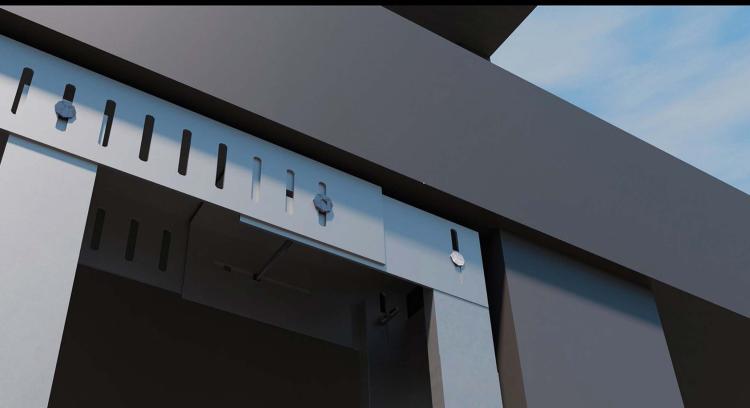
Redefining how dimensional discrepancies in concrete and steel primary structural frames are addressed, our Lightweight Engineered Adjustable Frame (LEAF), has been specifically designed and developed by Frameclad’s technical team to overcome these challenges.
A light steel frame infill system, precision-engineered for both internal and external walling, the hallmark of LEAF is its 40mm four-axis adjustability. Unlike traditional light steel infill systems that demand on-site cutting, welding or shimming, LEAF can be aligned on-site in all directions – vertically, horizontally and laterally – with complete ease. Once in position, the mechanism is simply locked into place, delivering a robust fit without hot works or specialist tools.
Factory manufactured under rigorous quality control, each panel arrives prelabelled, performance-tested and ready to install – combining the assurance of offsite fabrication with intelligent, adaptable design. Engineered for a wide spectrum of external cladding systems and capable of achieving fire ratings of up to 120 minutes, LEAF also meets stringent acoustic and thermal standards. Its genius lies in its simplicity – a true ‘fit first time’ system that improves safety, fast-tracks building programmes and adapts effortlessly to the challenges of retrofit and office to apartment conversions.
Designed for real-world demands
LEAF is a practical enabler of high-quality residential conversions and retrofit projects, where ‘historic as built’ conditions often bear little resemblance to drawings, this adaptability is invaluable.
LEAF also delivers prelim savings as the requirement for scaffolding and mast climbers can be introduced much later in the building programme.
Contractors gain programme certainty, with less rework and reduced labour time, while designers can specify with confidence knowing the system will accommodate real-world variances.
Fire safety at the core
Whilst adaptability is critical, safety must come first. The introduction of the Building Safety Act has fundamentally changed the way high-rise residential projects are delivered, with far greater emphasis on product traceability, rigorous testing and a ‘golden thread’ of compliance. LEAF has been subjected to a comprehensive programme of independent fire resistance tests under BS EN 1364-1 (non-loadbearing walls) to ensure compliance with these demands. Fire resistance ratings of 60, 90 and 120 minutes can accurately be achieved. If the brief demands:
• A1 non-combustible boarding can be used for external and internal lining
• Factory fitted with stone, glass or mineral wool insulation can contribute to enhanced thermal performance and fire resistance
These results provide confidence not only for regulatory approval but also for residents who rightly expect that their homes meet the very highest safety standards.
Building Safety Act compliance
The Building Safety Act 2022 places responsibility squarely on duty holders – developers, designers, and contractors – to ensure that buildings are safe both during construction and throughout occupation. Systems specified for residential projects, particularly those above 18m, must therefore demonstrate:
• Non-combustibility of all primary materials
• Traceability of supply chain and testing evidence
• Clear, documented performance data for fire resistance, acoustic, and thermal properties.
LEAF has been developed with this framework in mind. For developers, this reduces compliance risk and ensures smoother progression through planning and gateway reviews. As our cities evolve, the retrofitting of existing commercial stock into residential apartments will play a vital role in delivering sustainable growth and meeting housing demand. Success in this sector depends on building systems that are adaptable, safe, compliant and efficient.
As the industry embraces modern methods of construction (MMC) and leans into the challenges of safety and sustainability, we operate very much as a trusted partner, delivering highperformance, accredited and innovative solutions that protect people, property and investment.
Stay in touch:






